9/ Learnings from the Feedbacks:
From the feedback gathered during sharing sessions, we identified strengths and areas for improvement in our performance. Key takeaways include:
- Audience Engagement:
- Clarify the audience’s role—whether they are passive observers or active participants. Ambiguity in this role can lead to confusion.
- Eye contact and unexpected interactions with the audience can enhance engagement.
- Concept and Structure Clarity:
- Ensure the audience understands the narrative despite abstract segments. The balance between reality and artificiality needs refinement to avoid confusion.
- Space and Staging:
- Fully utilize the performance space, especially in chaotic scenes, to enhance the experience.
- Attention to blocking and seating arrangements is crucial to avoid obstructed views and promote immersion.
- Movement and Choreography:
- Focus on a specific movement technique for cohesion. Simplifying the movement vocabulary can enhance grounding.
- Control chaotic moments to avoid overwhelming the audience. Movements should convey intention rather than overt emotion.
- Sound and Atmosphere:
- Sound design is essential for atmosphere. Amplifying sound and simplifying gestures can create more impactful scenes.
- Further contrast between natural soundscapes and artificial elements can heighten tension.
- Props and Timing:
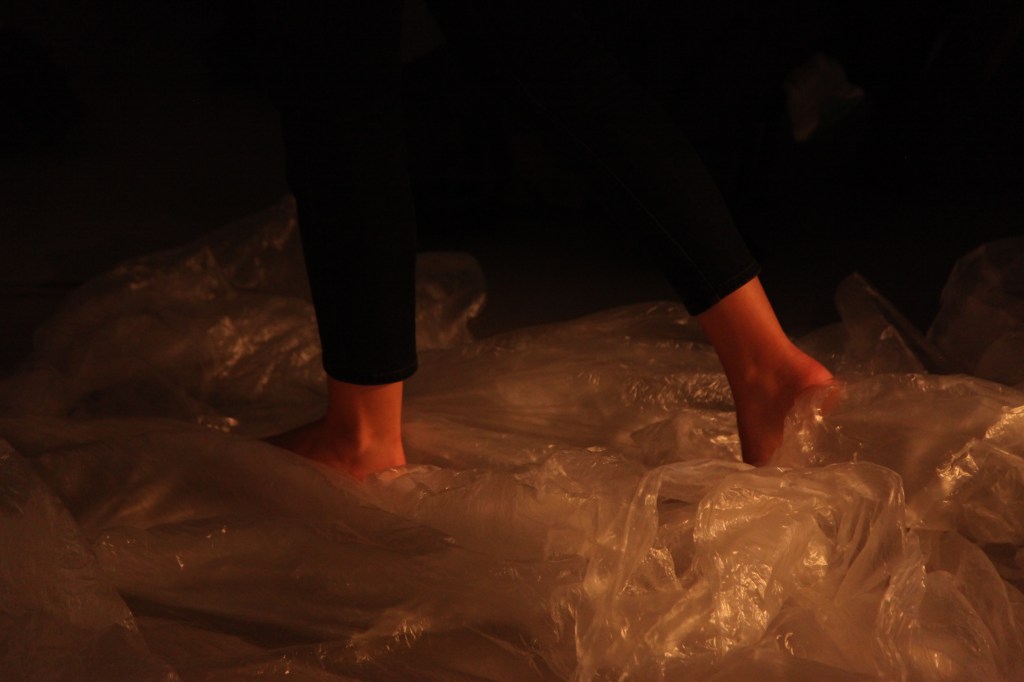
- Refresh props, especially those involving plastic, to avoid repetitiveness. Staggering the entry of performers and props can improve pacing.
- Allow scenes to breathe with more controlled timing to keep the audience engaged.
- Theme and Metaphor:
- Explore themes of nature’s resilience and the tension between nature and civilization with greater clarity.
- The eco-futuristic vibe should be consistent, refining connections to 70s and 80s eco-consciousness.
Actions Taken:
- Clarify Audience’s Role: Clearly define whether the audience participates actively or passively. For example, we involved some audience members in a “picnic” scene to illustrate pollution and consumption, enhancing their emotional connection to the theme.
- Focus on Cohesion: Simplified movement, streamlined transitions, and refined core thematic elements to reduce fragmentation.
- Improve Use of Space: Planned better staging and audience placement. In our performance of Elementals, we experimented with seating arrangements to enhance thematic resonance, ultimately choosing a scattered, wave-like setup that reflects nature’s interplay with chaos.
- Elevate Atmosphere through Sound: Utilized soundscapes to heighten tension, incorporating multilingual text alongside projections to emphasize the global impact of plastic pollution.
By implementing these insights, we refined our performance to be more cohesive, engaging, and impactful, while remaining true to its core themes of nature, human interaction, and environmental conflict.
 yuki
yuki 